
If you are learning Japanese and want to explore further, you may want to know your current language ability.
But which Japanese exam should you take in India to check your language skills and reach your long-term learning goal?
Most Indian learners are familiar only with the Japanese Language Proficiency Test (JLPT). Some may also be aware of the Nihongo Achievement Test (NAT). But that’s it!
You may be surprised to learn that at least 13 types of Japanese language exams are available worldwide.
Many Japanese exams are available today to meet various needs and skill levels. No matter your reason — careers in Japanese, study abroad, hobby, or better communication — there’s a Japanese language test for you.
However, not all these choices are available in India for various reasons.
Which Japanese tests can you take in India? Which exam is more beneficial, and how do they differ from each other? Let’s find out all!
Table of Contents
- 6 Most Common Types of Japanese Tests in India
- Final Words on which Japanese proficiency test to choose
6 Most Common Types of Japanese Tests in India
As of 2026, you can take one of the 6 Japanese language exams in India.
Though all tests aren’t the same, they all offer a helpful way to measure your knowledge of Japanese. The choice depends entirely on your needs.
Before registering for a test, review the examination format, fee, dates, and whether a test center is available in your city.
I hope this comprehensive guide to Japanese language exams in India helps you make an informed decision.

1. Japanese-Language Proficiency Test (JLPT)
The Japanese Language Proficiency Test (JLPT) is an effective way for non-native speakers to demonstrate their Japanese skills. This is the best-known and most respected Japanese test worldwide.
The Japan Foundation (JF) and Japan Educational Exchanges and Services (JEES) administer the test in more than 100 countries worldwide.
There are so many advantages to taking the JLPT!
It can assist you with study or work visas in Japan, job opportunities, and scholarships. Plus, it’s a great way to know your current level and build confidence. JLPT is valuable and opens up a world of possibilities.
(i) JLPT test structure, format, levels
The JLPT has been administered since 1984 and focuses on fundamental skills such as vocabulary, grammar, reading, and listening.
There are no speaking and writing tests, which has raised doubts about whether it considers students’ overall Japanese proficiency. Still, JLPT remains the most popular choice among Japanese learners in India.
JLPT has five levels, from N5 (beginner) to N1 (the most advanced). The total score is 180 marks. To pass, you must achieve a specific score in each section and an overall score.
The N4 and N5 sections have 2 sections: (i) Vocabulary & Grammar and Reading, and (ii) Listening. N1, N2, and N3 have 3 sections: (i) Vocabulary & Grammar, (ii) Reading, and (iii) Listening.
N5 and N4 cover day-to-day conversation, basic vocabulary, and phrases. Both cover 100-300 Kanji and 400-1500 Japanese words.
The N3 has intermediate grammar, and you need to master around 600 to 700 Kanji and 3000 to 4000 Japanese words.
If you aim for N2 and N1, you’ll deal with tricky grammar, conversations, honorifics, and sentences. For N1, which is the most challenging level, you need 2000 to 2500 kanji and over 10,000 words.
Remember that this is an estimate of the number of kanji and words, as they do not publish the exact syllabus.

(ii) Test Centers, Exam Dates, and Fees for JLPT
- In India, students can take the JLPT twice yearly, on the first Sunday of July and December. This year’s dates are 5 July 2026 and 6 December 2026. You need to apply 2-3 months in advance.
- There are 8 JLPT test centers in India: New Delhi, Bengaluru, Pune, Mumbai, Kolkata, Chennai, Santiniketan (West Bengal), and Karur (Tamil Nadu).
- The cost varies depending on the level you choose. For 2026, the JLPT fee in India ranges from INR 1400 to INR 2100.
There are many resources available to help you prepare for the JLPT.
You can practice grammar and vocabulary through flashcards. You can also take mock exams and check past test papers.
You can use books, apps, podcasts, audio lessons, and videos for help. You can also enroll in online language classes or join any Japanese institute.
The JLPT shouldn’t be a cause of stress for you. You can overcome Hiragana, Katakana, and Kanji with effort, dedication, and regular study. JLPT is an exciting gateway to dive into the world of Japanese!
2. Nihongo Achievement Test (NAT-TEST)
The Nihongo Achievement Test (NAT) is the second most well-known Japanese test after the JLPT. It checks and certifies the proficiency of speakers whose mother tongue is not Japanese.
The Senmon Kyouiku Publishing Company operates the NAT in Shinjuku, Tokyo. Each country offering the test has a local office and support staff to ensure the smooth management of this exam.
The NAT test helps students who want to work or study in Japan. Many Japanese universities and organizations accept the scores as proof of language skills.
Another significant usefulness is that the test gives a detailed score report. This record shows test takers what they do well and what they need to improve. There are no specific conditions for taking the NAT test.
(i) NAT-Test structure, format, levels
Over 150,000 people take the test annually. It follows the same format and structure as the JLPT. Thus, if you study for the JLPT, you can also take the NAT with the same preparation.
The NAT test has three key elements: language knowledge and grammar, listening, and reading.
NAT has five levels: Q1, Q2, Q3, Q4, and Q5. Q1 is the most difficult, and Q5 is the easiest. Each level corresponds to a JLPT level: NAT Q1 is equivalent to JLPT N1, and Q5 is equivalent to N5.
The simplest Q1 focuses on everyday words, grammar rules, phrases, and sentences. The most advanced Q5 requires advanced vocabulary, complex grammar, kanji, and reading and listening comprehension.
Levels 1 and 2 have a language section on reading, grammar, and vocabulary. It also covers reading and listening comprehension.
Levels 3, 4, and 5 have two language sections. The first covers kanji and vocabulary, while the second focuses on grammar and reading. Both levels also include a listening part.
On exam day, test takers will need several hours to complete the exam.
(ii) Test Centers, Exam Dates, and Fees for NAT
- They arrange the NAT Test nearly every month in India. You can take it 12 times in 2026. Not all centers conduct tests on all dates, so don’t forget to cross-check.
- As of 2026, there are 4 NAT exam centers in India (Mumbai, Pune, New Delhi, and Chennai).
- The fee for NAT in India ranges from INR 2300 to INR 3500, depending on the level.
Japanese JLPT Vs. NAT-Test

JLPT and NAT are two official global tests used to assess Japanese proficiency among non-native speakers. The levels, test structure, format (e.g., MCQs), syllabus, and fees are broadly similar.
What makes the JLPT different from the NAT?
There are only 4 primary differences between the 2 Japanese exams, aside from the organizations administering them.
JLPT is better known and more widely recognized than NAT. JLPT’s international acceptance makes it a superior choice for long-term career scope in Japanese or academic goals. NAT is also popular but less favored than the JLPT.
Second, NAT has an edge for test frequency. The JLPT is available only twice a year, whereas NAT is available several times a year, depending on the region.
NAT is ideal for those needing quick results, facing tight deadlines, or having urgent work or visa requirements.
Third, there are more than 300 JLPT test centers in approximately 94 countries. In contrast, all 83 NAT testing centers are limited to 16 Asian nations. Thus, JLPT offers more test centers.
Plus, your location may not have test centers for both. That’s one reason to choose NAT or JLPT, depending on the availability of exam centers.
For example, if you live near Kolkata or Bengaluru, you have a JLPT center but no NAT option. You can choose either test in cities where both options are available.
The JLPT exam focuses on reading and listening skills, making it suitable for students and professionals. In contrast, the NAT exam is more about general Japanese and communication.
Some linguists and Japanese learners also find the JLPT easier than the NAT, but this is more of an opinion than a verified hard fact.
3. Business Japanese Proficiency Test (BJT)
The Business Japanese Proficiency Test (BJT) checks your Japanese skills in a workplace setting. Many approved institutions in Japan support this exam.
The BJT differs from the JLPT in that it focuses on business language. This makes it an outstanding choice for anyone wanting to work in Japan or with Japanese companies.

(i) BJT Test structure, format, levels
The BJT scoring system ranges from 0 to 800 points. It has six levels, from highest to lowest: J1+, J1, J2, J3, J4, and J5. The test has three components: listening, reading, and combined listening and reading.
This is a computer-based test (CBT). After you take it, you must wait 3 months before retaking it. You can choose any day to take the exam that works for you.
BJT covers vocabulary, grammar, business etiquette, communication skills, and document reading. It also includes meetings, negotiations, presentations, emails, and business correspondence.
The BJT helps you learn more about Japanese business culture and customs. It also allows companies to decide whether candidates can work well in business without relying on JLPT levels.
The exam costs JPY 7,000 in Japan. Prices vary by country and test location.
(ii) Test Centers, Exam Dates, and Fees for BJT
- There is no fixed exam date for BJT. You can apply and take the test on any date that is convenient for you.
- As of 2026, there are 4 BJT exam centers in India (New Delhi and Hayakawa in Chennai). Mumbai and Pune are 2 other centers.
- The fee to appear for a BJT in India is USD 32, approximately INR 2800.
4. Examination for Japanese University (EJU)
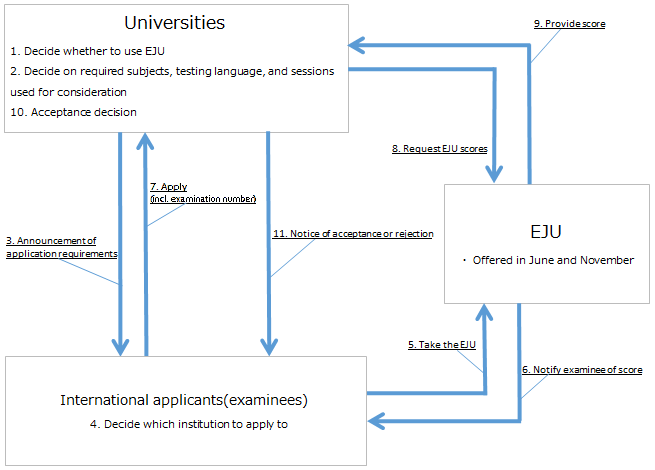
The Japanese University Admission (EJU) exam is for international students seeking admission to universities in Japan. It helps non-Japanese students pursuing undergraduate or postgraduate degree courses.
The EJU started in 2002 to replace the JLPT. The Japan Student Services Organization (JASSO) manages the exam for the Japanese government.
First, students should check if the universities they are interested in require the EJU for applications. Next, they need to take the necessary exams. JASSO will then send a score report to the university.
(i) EJU Test structure, format, levels
EJU subjects include Japanese as a Foreign Language, Science (Physics, Chemistry, and Biology), Mathematics, and Japan and the World.
You can select subjects according to the conditions of the Japanese university where you want to study. You can prefer either English or Japanese, but Japanese is required for a Japanese as a foreign language paper.
The exam has two parts: (i) reading and listening comprehension, and (ii) writing. The language part lasts 125 minutes, while the Science, Math, and Japan & the World parts each last 80 minutes.
The question format is multiple-choice and written. The score ranges from 0 to 200 for all subjects. For the Japanese, it’s an MCQ worth 0 to 400, with the remaining 50 for written answers, totaling a maximum of 450.
Students can find past exam questions and sample answers on the official EJU websites. They can also register online for the next exam before the deadline.
(ii) Test Centers, Exam Dates, and Fees for EJU
- JASSO conducts the EJU exam twice a year in India. This year’s dates are 14th June 2026 and 8th November 2026 (Both Sundays).
- There is one test center at Sri Venkateswara College in Delhi, India. MOSAI of Delhi organizes the test on behalf of JASSO.
- The EJU examination fee is INR 1,300.
5. Japan Foundation Test for Basic Japanese (JFT-Basic)
The Japan Foundation offers the JFT-Basic test for non-native Japanese speakers.
The JFT-Basic was designed by the Japan Foundation in April 2019 to assess the Japanese skills necessary for daily life in Japan. It helps to handle daily conversations and manage daily activities without problems.
Based on the CEFRL levels and the JF Standard for Japanese Language Education, this test assesses your Japanese proficiency. Once you pass the JFT-Basic, you get the “Specified Skilled Worker” residency status.

(i) JFT-Basic Test structure, format, levels
There are two types of JFT-Basic: individual and group testing. The latter is for the organization or group of students.
The test is done on a computer. You answer questions by reading on-screen prompts and listening through headphones. You can only take the test at official test centers in your country.
JFT-Basic is a single 60-minute test with four parts. It includes vocabulary and script, conversation and expression, and reading and listening comprehension. The total number of questions is around 50.
You can download materials to help you prepare for the JFT-Basic test.
If you score 200 or more out of 250, you will receive a certification at the A2 level, like CEFR. There are no skill-level divisions for this test. You get your results on the same day as the test.
You can retake the test after a minimum gap of 45 days between the last and the following test dates.
Test Centers, Exam Dates, and Fees for JFT-Basic
- JF administers the JFT-Basic several times a month in India. You can check the upcoming exam schedule to register in advance.
- 3 Exam centers are in India (Bengaluru, Guwahati, and Gurgaon).
- The JFT-Basic fee in India is INR 3,540 for 2026.
6. Japanese Computerized Adaptive Test (J-CAT)

The Japanese Computerized Adaptive Test (J-CAT) is an online exam that quickly and reliably checks your Japanese language skills. Many self-learners, students, and professionals prefer it for this reason.
Unlike regular tests with set questions, the J-CAT changes the difficulty based on your answers. This personalization helps you assess your language skills more accurately and efficiently.
J-CAT Test structure, format, levels
The J-CAT tests four main areas: listening, grammar, vocabulary, and reading. The highest possible score is 400 points, with each section contributing 100.
The J-CAT exam lasts 45–90 minutes. Since this is a flexible test, the number and type of questions will vary, so the duration will also vary.
To do well on the J-CAT, practice grammar, expand your vocabulary, and improve your listening. You can also find various study materials, such as language learning flashcards, apps, textbooks, and podcasts.
You can also try answering sample questions on the official J-CAT website, which offers mock tests and sample papers for practice.
After the test, you will receive a report outlining your strengths and weaknesses. This report can guide your study plans and help you focus on areas that need improvement.
Test Centers, Exam Dates, and Fees for J-CAT
- Since the J-CAT is 100% online, you can take the test anywhere with internet access, including India.
- There is no fixed test date. You can apply online at any time via the J-CAT portal. Complete the form, receive an email, and then take the test online.
- The fee is 1,100 yen (challenge), 2,200 yen (performance), and 4,400 yen (certificate). This converts from roughly INR 600 to INR 2500.
Final Words on which Japanese proficiency test to choose

With so many Japanese language tests available, selecting the right one can be difficult.
Each test has its own strengths and weaknesses, so match the test to your needs. Whether you need it for education, daily communication, or job requirements, there is a test to suit your needs.
First, consider your current Japanese level and what you want to achieve. You might need a test to achieve specific goals, such as for business, career, or college studies in Japan.
The JLPT is the top choice for anyone seeking a globally recognized and accepted Japanese certification. It can be valuable in every field, including long-term job prospects involving Japanese.
NAT-Test is the 2nd choice for a comprehensive Japanese certification. It’s an excellent option for quick results and certification if you can’t wait for the next JLPT date.
The BJT is ideal for anyone seeking a corporate job in Japan, India, or elsewhere that demands strong Japanese business skills.
Choose EJU if you intend to study undergraduate, postgraduate, or any higher studies at a university in Japan. JFT-Basic is for candidates seeking to assess foundational skills and earn credentials.
If a nearby test center for the popular Japanese exam isn’t available, think of J-CAT. But remember, you need a proper understanding of the test content, and resources are limited. It is also not widely accepted.
Once you choose a test, learn about its format, nearby exam centers, and scheduled dates.
Then, practice regularly with resources and guidance, prepare, and ace the Japanese test of your choice. Concentrating on your studies is vital to success.
Do you know of any other Japanese language tests in India? Share your opinion or question in the comments. Happy studying, and good luck!


Hi sir tku for your effort and you have provided so much information about Japaneese language.Really no words to express
Welcome, Lavanya :)
JFT exam related questions
What question you have?