I have been learning, teaching, reading, and writing about foreign languages for over a decade. Improving listening skills is one of the most frequently asked questions for those already learning a language. Are podcasts really worth it?
Listening is critical to anyone’s journey, regardless of the language you’re learning or your current level.
You cannot truly understand a language without developing an ear for that tongue. It also impacts how we speak, read, and write.
The most effective way is to speak with a skilled teacher, a native speaker, or someone who speaks well.
However, that may not be possible for most learners living far from where it is widespread or who do not study through immersion.
It is common for learners to try various language methods and tools to improve their listening skills. To do that, they listen to audio lessons, listen to music, and watch videos.
Fortunately, many resources can help you learn and improve your listening skills. Some are okay, but most aren’t that good.
Music and audio lessons don’t always reflect how we speak in everyday life. Further, they are not natural tools and are less effective for learners.
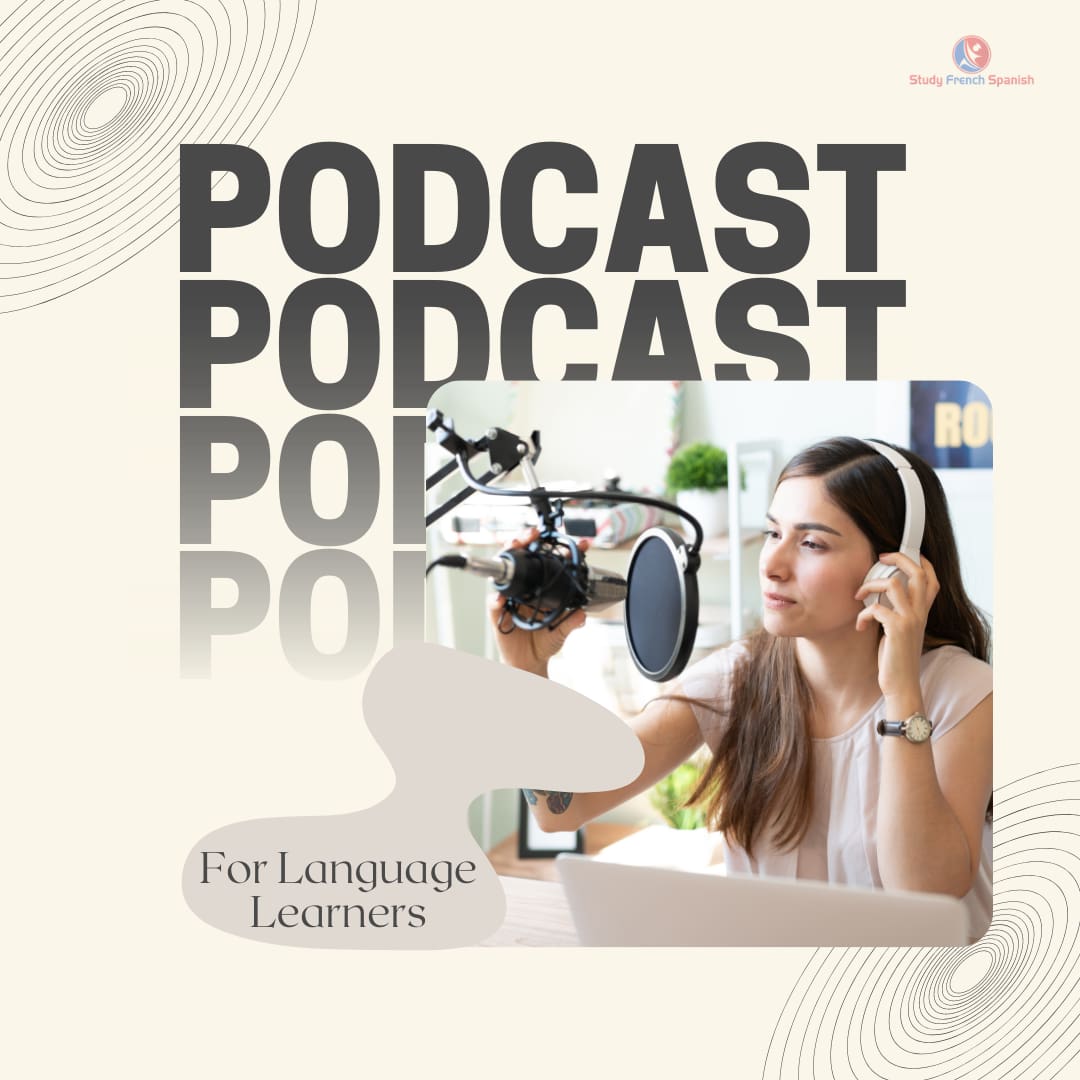
To address this, you can listen to podcasts to improve your language skills.
It is an incredible way to learn, practice, and improve the target language, especially pronunciation. It also helps build vocabulary, phrases, and sentences, as well as speaking and reading skills.
So, let’s explore the benefits of Podcasts and how to do it.
Table of Contents
Benefits of Language Learning with Podcasts
Today, you have endless resources to learn a language of your choice. So, of all the options, why should you listen to Podcasts in the first place?
You might wonder how Podcasts can actually help you learn a foreign language. Let’s explore the top advantages of Podcasts!
1. Podcasts help to cut down on screen time
According to various studies, excessive screen time strains the eyes and can lead to vision and other health problems. It also affects our sleep and leads to a more sedentary lifestyle. In short, there are many drawbacks.
All online language resources, such as face-to-face study, video lectures, listening exercises, and apps, require sitting in front of a screen.
Learners are engaged in work that requires visual attention and vary in their screen time preferences.
This is where language-learning podcasts are unique and shine!
They do not count as screen time on smartphones or laptops. This is because we either switch the screen off or don’t need to watch it constantly to read or listen.
You can choose your favorite channel, host, topic, duration, and difficulty level. Finally, you can start listening to Podcasts on the go!
You can listen and entertain yourself while commuting, doing daily chores, or walking in the park. Learn and practice wherever you are and whenever you wish.
This eyes-free, hands-free learning method improves your multitasking skills. As a result, you can enhance your language skills even with a busy schedule and reduce eye strain.
2. Convenient and Time-efficient
A notable advantage of podcasts is their flexibility and convenience. You can easily subscribe, download the audio to your mobile or laptop, and access it anytime, anywhere.
Whether you’re traveling on the metro, eating at a cafe, buying groceries, or at home, Podcasts help you understand your target language. And in a better, more convenient, and relaxed way.
Because podcasts on smartphones are easily accessible anytime, you can turn back to them. This encourages active learning in your comfort zone on the move.
That is why podcasts are thriving. They’re available when a listener wants to listen, whether the podcast is two years old or the day it was broadcast.
Listeners can sometimes become hooked on podcasts when there are many episodes that can be played back-to-back. Do you miss something? No problem; with a click, you can stop, start, and hear again.
This enables binge-watching, which improves your target language’s listening and speaking skills. And all this isn’t boring—you will have lots of fun!
3. Podcasts are almost free
Most other language resources cost money, either one-time or on a subscription basis. On the other hand, podcasts are usually free.
You can listen to and download music from dozens of music streaming platforms. The list is never-ending: Google Podcasts, Apple Podcasts, Amazon Music, Overcast, Audible, Player FM, Spotify, TuneIn, and Stitcher.
Some of these services offer free advertising to users. But the quality of the content you receive far outweighs those occasional pop-ups. You can also pay for ad-free, better sound quality, exclusive audio, and other features.
Of course, many paid options require recurring costs. While some are excellent at what they do, it is still optional for most of you.
You can start with the free ones. Later, if you need premium ones, you can request them. Then, you can consider purchasing 1-2 subscriptions to elevate your language skills.
4. Improve your Listening and speaking skills
Language is all about communication. To do that, we need four basic language skills: reading, writing, speaking, and listening.
All four are necessary depending on the situation and needs. Yet speaking and listening play a much more essential role in personal and professional life.
And these two abilities are also the best way to learn any language. By listening to native or fluent speakers, you gain a deep understanding of the language you’re studying currently.
Native speakers create most voice content, allowing you to practice pronunciation in the actual way it is spoken. You will also learn how locals use the language, including slang and idioms, in real life.
Depending on your listening needs and skills, you can speed up or slow down the episode to better understand it.
Podcasts can improve your pronunciation, accent, syllable stress, and intonation. This also trains your ear and mind for the language you’re learning.
Repeating what you hear is the quickest way to improve your speaking and listening.
5. Improve your vocabulary and grammar
Podcasts provide language learners with exposure to a wide range of topics, stories, and situations.
Research shows that incidental exposure to academic vocabulary through listening to stories helps students learn the meaning of unknown words.
Besides listening and thus speaking, it also helps you increase your vocabulary. Our brains are wired to achieve that. As a language learner, your level is usually determined by the progression of your words.
Your fluency level increases as you learn more words. While grammar helps, vocabulary always plays the most prominent role. Knowing more words will give you much more confidence when conversing with locals.
Listening to a language podcast will help you expand your vocabulary. It also gives you a feel for the different grammar rules and shows you how to make good sentences in that language.
For a better learning experience, keep track of unfamiliar words on the podcast you’re listening to. Then, if you don’t understand the context or meaning, look for a dictionary and get a complete sense of what it means.
6. It enhances your reading skills
The podcast is a superb online language-learning tool for improving your listening and reading skills.
If you read the transcripts and listen to the audio simultaneously, you will likely improve your overall language skills. When you read the words, you will know exactly how to pronounce and use them.
You can always slow down, speed up, rewind, forward, or pause to match your reading pace. Further, you can always reread something you didn’t get when you first heard it.
This may make it feel more like reading than listening to a podcast. However, having both written and audio versions can significantly help you learn new languages.
Another benefit of reading and listening is that doing them simultaneously increases focus and attention span.
Remember, not all transcripts are available for all podcasts. Finding the full, suitable transcripts of the podcasts before you start playing will save you a lot of time.
7. Get a better understanding of culture
Language and culture are closely related. You need to understand their culture to have friendly conversations with people in the language you’re learning.
Podcasts do not just help you learn vocabulary and grammar; they also help you sound correct. They also cover diverse aspects of a country’s culture, including those where language is valuable.
Listening to podcasts provides deeper insight into native speakers’ cultures and traditions. Hear how they speak, and you’ll learn about their society, practices, festivals, foods, customs, etc.
Most foreign-language podcasts also make studying entertaining. For example, if you listen to a popular Korean-language podcast. Then, chances are you will discover episodes of Kpop and K-drama.
Likewise, listening to a French-language podcast could teach you about Edith Piaf and Jacques Brel. You will also receive the latest news from Francophone nations, updates on the Eiffel Tower and Montreal, French classes near you, and the different types of Baguettes served in Paris.
You’ll often study the cultures and countries of your target language. Many language podcasts include cultural discussions in their host-guest conversations.
8. A variety of podcasts for everyone
There are many types of podcasts.
Podcasts are available on a wide range of topics. Do you fancy podcasts for learning Spanish? K-movie? Life in Japan? Careers in the Japanese language or Japan? Literature?
Podcasts are available for all these topics. There is something for everyone based on taste and need.
Students often get overwhelmed by the number of podcasts available and don’t know which to choose. I advise trying a few to decide which is right for you.
It is vital to try a few and see which format and style you prefer. Since most are free, expect some platform-based subscriptions, and keep checking until you find great options and what you want.
Pick a topic of interest, difficulty level, and goal, and get started.
Can you learn a language only through podcasts?
The short answer is no!
Podcasting is a modern language-teaching platform across topics, fields, and age groups. The technique can help you improve your foreign language skills. However, I would suggest not relying solely on one language tool, such as podcasts.
Podcasts can indeed be convenient and suitable. This is because most of you listen to podcasts while you work in the background.
But this will not get you anywhere if you is to learn a new language from scratch.
Just listening will not take you to the advanced level. You may even eventually lose your passion and interest.
It is best used as a supplement to enhance your existing knowledge and listening skills.
Nothing is more important than an experienced teacher for success. But by combining podcasts with other standards and language hacks, you can likely improve your ability to speak the target language.
Final Words: Should Language learners use Podcasts?
With so many language resources, podcasts are a valuable study tool for language enthusiasts. By doing so, you can achieve higher levels of fluency.
And why not?
It is readily accessible and free, and it supports challenging listening, reading, and vocabulary. It also covers a wide range of topics that interest and engage those who don’t use enough languages in their daily lives.
It is an excellent approach to enhancing your listening. It also offers the opportunity to learn something new. Podcasts can also help increase vocabulary and improve pronunciation.
If you are convinced, you can join the top language learning podcasts for your chosen level and topics. At the same time, some podcasts may be too difficult to understand. So, you can use transcripts to create a more in-depth study.
You can start with simple and short ones that are easier to grasp. Finally, you can move on to more complex and relevant ones as you progress.
What do you think of Podcasts as an effective language-learning tool? Do you have any perspectives to share? Write in the comments below!


